Stonehenge
One Radian at Stonehenge
The circle measures itself on the shortest day of the year
Stonehenge sits at about 51.1788° North.
Most people know the famous line: midsummer sunrise through the Heel Stone, and midwinter sunset along the same axis. That is the public story, and it is true.
There is another number at this latitude that almost never appears in ordinary accounts of the site.
On the winter solstice the Sun’s declination is about −23.5°. The hour angle at sunrise or sunset (the angular distance of the Sun from the meridian when it meets the horizon) is given by:
cos(HA) = −tan(latitude) × tan(declination)
Put Stonehenge’s latitude into that equation and the hour angle comes out as about 0.9999 radians, or about 57.29°.
One radian is 57.2958°.
So on the shortest day of the year, at this place, the Sun rises and sets at an hour angle that sits only a few thousandths of a radian from a pure mathematical constant: the angle made when an arc of a circle is equal in length to the circle’s own radius.
The near-match is specific to this latitude band. It is not a loose curiosity of southern England in general.
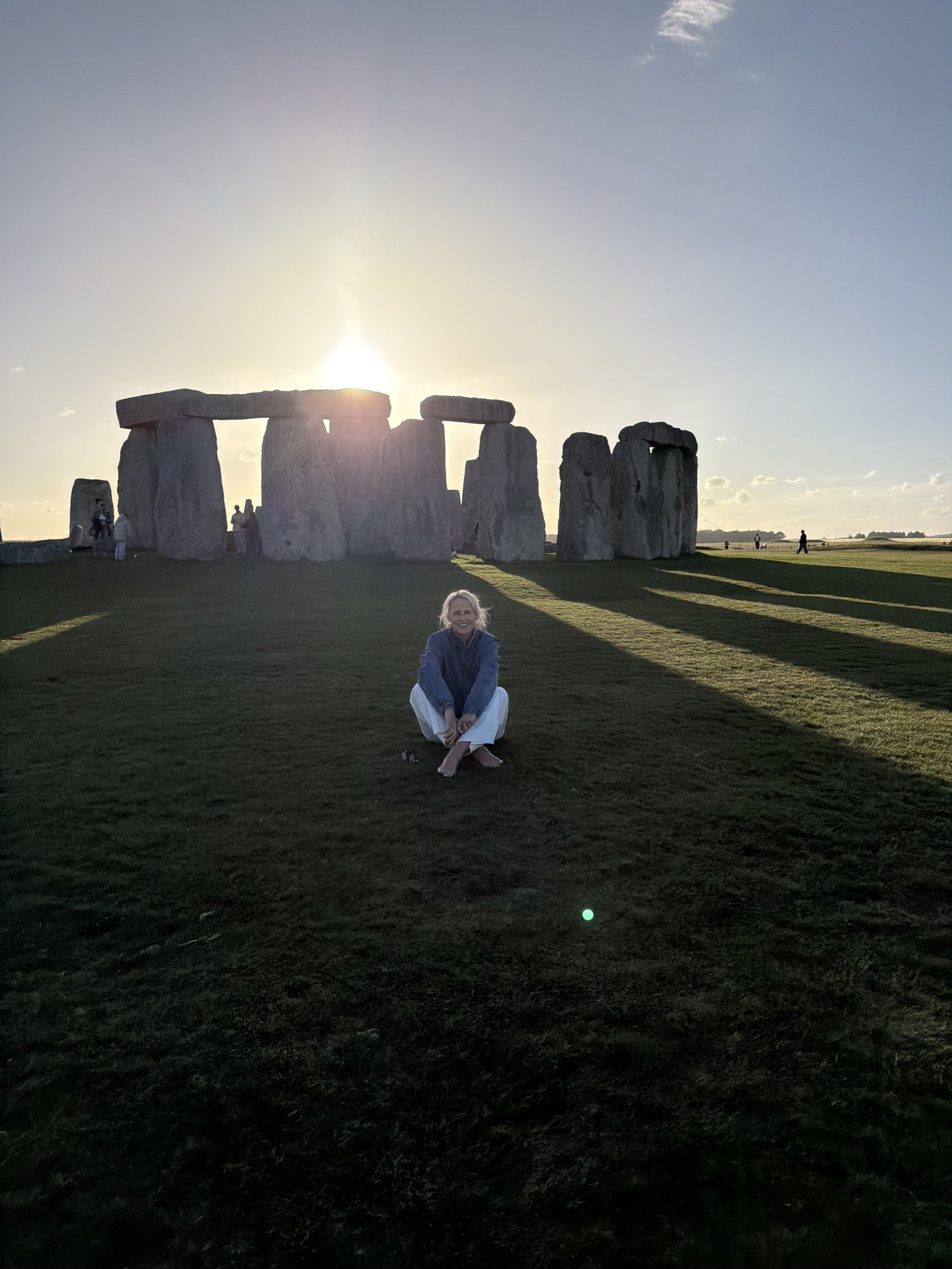
At Stonehenge. Photograph by Dawn Elizabeth Higgins. © 2026.
What one radian is
A radian is the natural unit of angle. Take a circle. Mark an arc on its rim equal in length to the radius. The angle at the centre is one radian.
A full circle is 2π radians. One radian is about 57.3 degrees. In the language of the circle, this is the clean unit. Degrees are a later counting habit. The radian is the circle measuring itself.
Time, the radian, and the language in stone
Earth turns a full circle, 2π radians, in one day. So roughly:
1 radian ≈ 3 hours and 49 minutes of Earth rotation.
At Stonehenge on midwinter, sunrise and sunset sit about one radian from noon in hour angle. That joins three things at once:
- Place (the latitude)
- Season (the shortest day)
- Circle measure (arc equals radius)
The monument does not invent that relation. The latitude produces it. The stones make it witnessable. Alignments, stations and open sight-lines turn a silent sky-fact into something a community can return to, year after year, without writing.
In that sense the stones and the location are the language. Not metaphor only. A working language of ground, light and measure. The circle on the plain holds the circle in the sky.
What this means about the builders
We cannot prove they used our word “radian.”
We can say more than nothing.
They look like people who could read place and season together, and then lock that reading into stone. Choosing (or keeping) a latitude where the darkest day’s solar hour angle is almost exactly the pure circle-angle is not the behaviour of builders who only piled mass for bulk. It fits a culture that watches, compares, remembers and returns.
The Heel Stone axis already shows careful solstice watching. The one-radian hour angle at the same ground shows that the place itself is tuned. Together they suggest builders who treated the land as instrument: not blank soil waiting for stones, but a position in the Earth–Sun geometry worth marking forever.
Proof level: a rare, clean coincidence plus a monument built for solar return. That is enough to change how we speak of them. They were not only labour. They were readers of the year.
What you can do with knowledge of one radian
Once you hold this unit, you can work without a degree-wheel.
- Lay out the circle. Rope equal to the radius; swing an arc; the central angle is one radian. Six such steps nearly close the full turn.
- Join angle to time. About one radian of Earth-turn is about 3 hours 49 minutes. Sky clock and circle measure speak the same unit.
- Survey with body and cord. Curves, stations and returns can be set by radius-arcs, the natural grammar of a circular site.
- Choose ground. If you want the shortest day’s hour angle to equal that pure unit, you are pushed toward this latitude band. Place becomes part of the calculation.
So the knowledge is practical. Geometry, timekeeping and site selection in one. That is why it belongs at Stonehenge: the site is where those three meet.

The circle at sunset. Photograph by Dawn Elizabeth Higgins. © 2026.
A note on novelty
This winter-solstice hour-angle observation has appeared in at least one specialised technical note. It is not common knowledge. Popular books and films repeat the Heel Stone sunrise. They almost never state that the hour angle at midwinter here is effectively one radian.
The finding is scarce in public understanding. This article places it where it can be seen: beside the solstice photographs, and beside the claim that geometry on this ground is not decoration. It is the message.
Photographs © 2026 Dawn Elizabeth Higgins. All rights reserved.