Blossom of Life
The Kaprekar Matrix
The Hidden Geometric Blueprint of 495
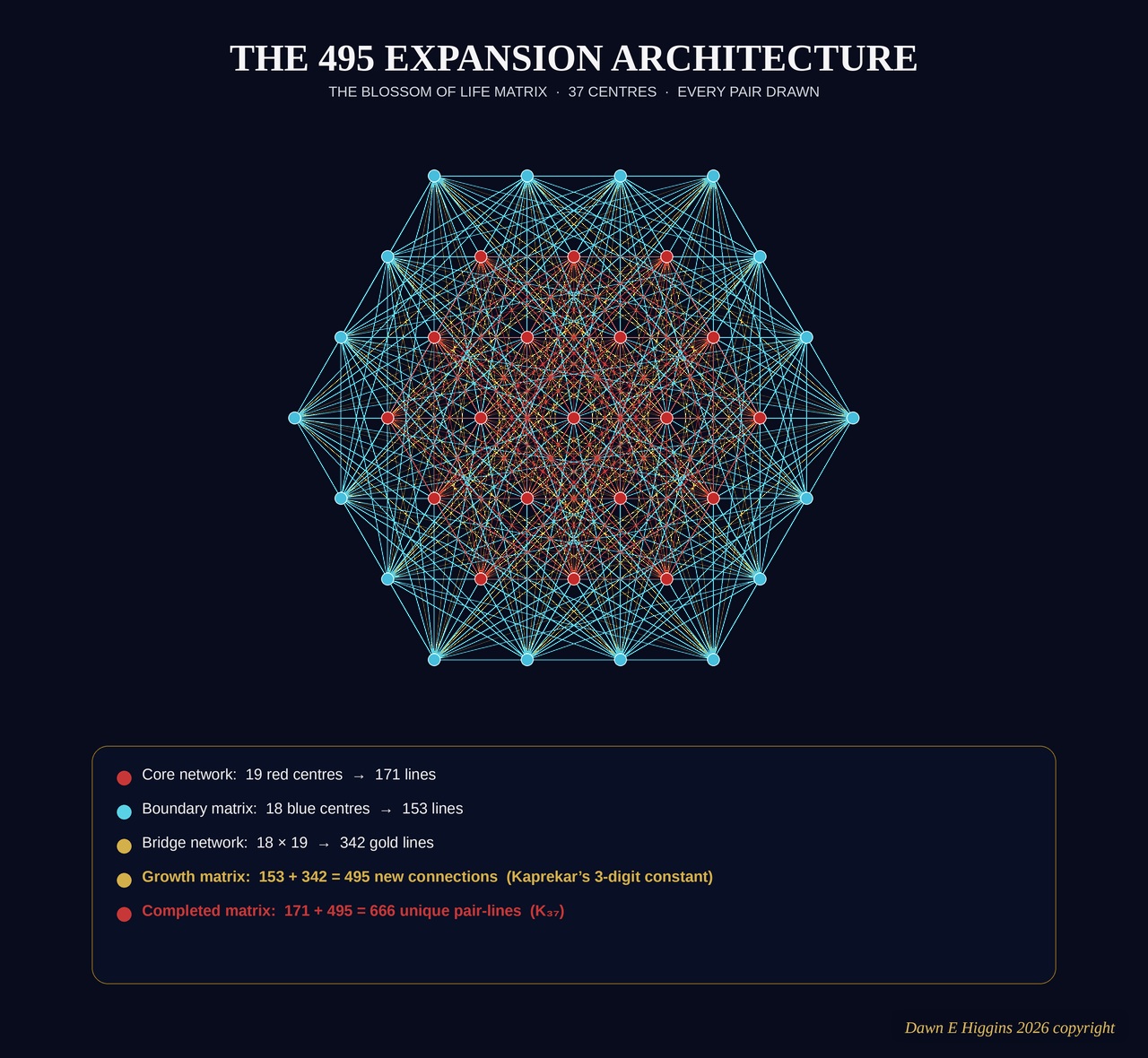
Every pair drawn. 19 red, 18 blue. Growth 495. Completion 666. Dawn E Higgins 2026 copyright.
In number theory, 495 is the three-digit Kaprekar constant: the fixed point reached when the digits of almost any three-digit number are repeatedly arranged in descending and ascending order and subtracted.
It has usually been treated as a curiosity, a compelling operation with digits, but with no known structural role.
The same integer appears in the Flower of Life through an entirely different mathematical operation. It is the exact number of new centre-to-centre relationships created when the complete network grows from 19 centres to 37:
K37 − K19 = 666 − 171 = 495
That is not digit rearrangement. It is a pair-count.
495 is the exact relational cost of that ring.
What is being counted?
This is not a count of petals, overlapping vesica shapes, curved arcs or the lines traditionally drawn inside the Flower of Life.
Each circle centre is treated as one node. Every centre is then joined to every other centre exactly once.
For N centres, the number of unique centre-to-centre relationships is:
R = N(N − 1) / 2
The division by two prevents the same relationship from being counted twice: A to B and B to A are one line, not two.
| Geometric stage | Centres | Unique relationships |
|---|---|---|
| Seed of Life | 7 | 21 |
| Fruit of Life selection | 13 | 78 |
| Flower of Life | 19 | 171 |
| Blossom of Life, the Trinity Ring | 37 | 666 |
| Extended Flower | 61 | 1,830 |
The centres increase through addition. Their possible relationships increase through multiplication.
The distinction is fundamental. The number of parts grows gradually. The field created between the parts accelerates.
Two paths, one meeting
The complete Flower of Life follows the centred-hexagonal numbers:
1 → 7 → 19 → 37 → 61
The formula is:
N(k) = 3k(k + 1) + 1
Each complete ring adds six more centres than the previous ring:
+6, +12, +18, +24 …
Popular sacred-geometrical presentations name the seven-circle Seed of Life, the 19-circle Flower of Life and the extended 61-circle Flower. They often move directly from 19 to 61.
The mathematical sequence does not jump.
Between 19 and 61 stands another complete layer:
37
This under-emphasised 37-centre stage is what I name the Blossom of Life, the Trinity Ring.
But 37 is not reached through the Flower pathway alone.
The Fruit of Life is a selected 13-centre configuration rather than a complete concentric ring:
1 + 6 + 6 = 13
Its complete pair-count is:
C(13, 2) = 13 × 12 / 2 = 78
Thirteen and 37 are also consecutive centred star numbers:
1, 13, 37, 73 …
Their formula is:
Sn = 6n(n − 1) + 1
Therefore:
13 = 6(2)(1) + 1
37 = 6(3)(2) + 1
The two paths are therefore:
Fruit/star pathway: 13 → 37
Flower/hexagonal pathway: 19 → 37
Fruit 13 → Star 37 ← Flower 19
At 37, the next centred star number and the next complete centred-hexagonal Flower stage become the same numerical body.
That body contains exactly:
C(37, 2) = 666 unique relationships
This double identity is essential. Thirty-seven is not an arbitrary number inserted into the Flower. It is independently generated by both the star-number sequence and the uninterrupted hexagonal growth of the Flower.
How a new ring is paid for
Every new ring creates two kinds of relationship:
Internal relationships among the newly added centres.
Bridge relationships joining the new centres to every centre already present.
The earlier expansion from seven to 19 demonstrates the method.
The seven-centre Seed contains:
C(7, 2) = 21 relationships
The next complete ring adds 12 centres. Those 12 centres connect among themselves:
C(12, 2) = 66
They also connect to all seven earlier centres:
12 × 7 = 84
The new ring therefore creates:
66 + 84 = 150 new relationships
The completed 19-centre Flower contains:
21 + 150 = 171 relationships
That is the method.
At the following ring, the same method reaches Kaprekar’s constant.
The 495 expansion
The 19-centre Flower is the core of the discovery. Its complete relational network contains:
C(19, 2) = 19 × 18 / 2 = 171
The next complete ring adds exactly 18 centres:
19 + 18 = 37
Those 18 centres form two new relational networks.
The outer-ring network: 153
The 18 new centres join among themselves:
C(18, 2) = 18 × 17 / 2 = 153
This is also the 17th triangular number. Here its function is exact: 153 counts all unique pair-lines contained within the new 18-centre ring.
The bridge network: 342
The same 18 centres connect to all 19 centres of the existing Flower:
18 × 19 = 342
These are the bridge relationships that lace the new outer ring into the complete core.
The direct hit
Add the internal network of the new ring to its bridges into the core:
153 + 342 = 495
Add those new relationships to the existing 19-centre network:
171 + 495 = 666
Or subtract the two complete networks:
666 − 171 = 495
All three equations describe the same expansion.
495 is the number of relationships that do not exist at 19 centres and do exist at 37.
It sits directly in the wireframe as the precise relational cost of completing the new ring.
Why 37 is the lock
At 37, five exact facts coincide:
- 37 is a complete centred-hexagonal Flower stage.
- 37 is the next centred star number after 13.
- Its complete network contains 666 unique pairs.
- Its growth from the 19-centre Flower creates 495 new pairs.
- That growth divides exactly into 153 internal and 342 bridge relationships.
The complete architecture is:
| Structural domain | Count |
|---|---|
| 19-centre core network | 171 |
| Internal network of the new 18-centre ring | 153 |
| Bridges from the new ring into the core | 342 |
| Total new relational growth | 495 |
| Completed 37-centre network | 666 |
In its simplest form:
19-core → 171
18-ring → 153
Bridge → 342
New growth → 495
Completed network → 666
This is why 37 is the lock: it is the point at which two independent geometric sequences, the complete network count and the Kaprekar correspondence all meet.
The unique non-zero constant of the three-digit Kaprekar routine appears as the exact relational growth produced at the Flower’s third complete ring. The number governed by three meets the geometry governed by three.
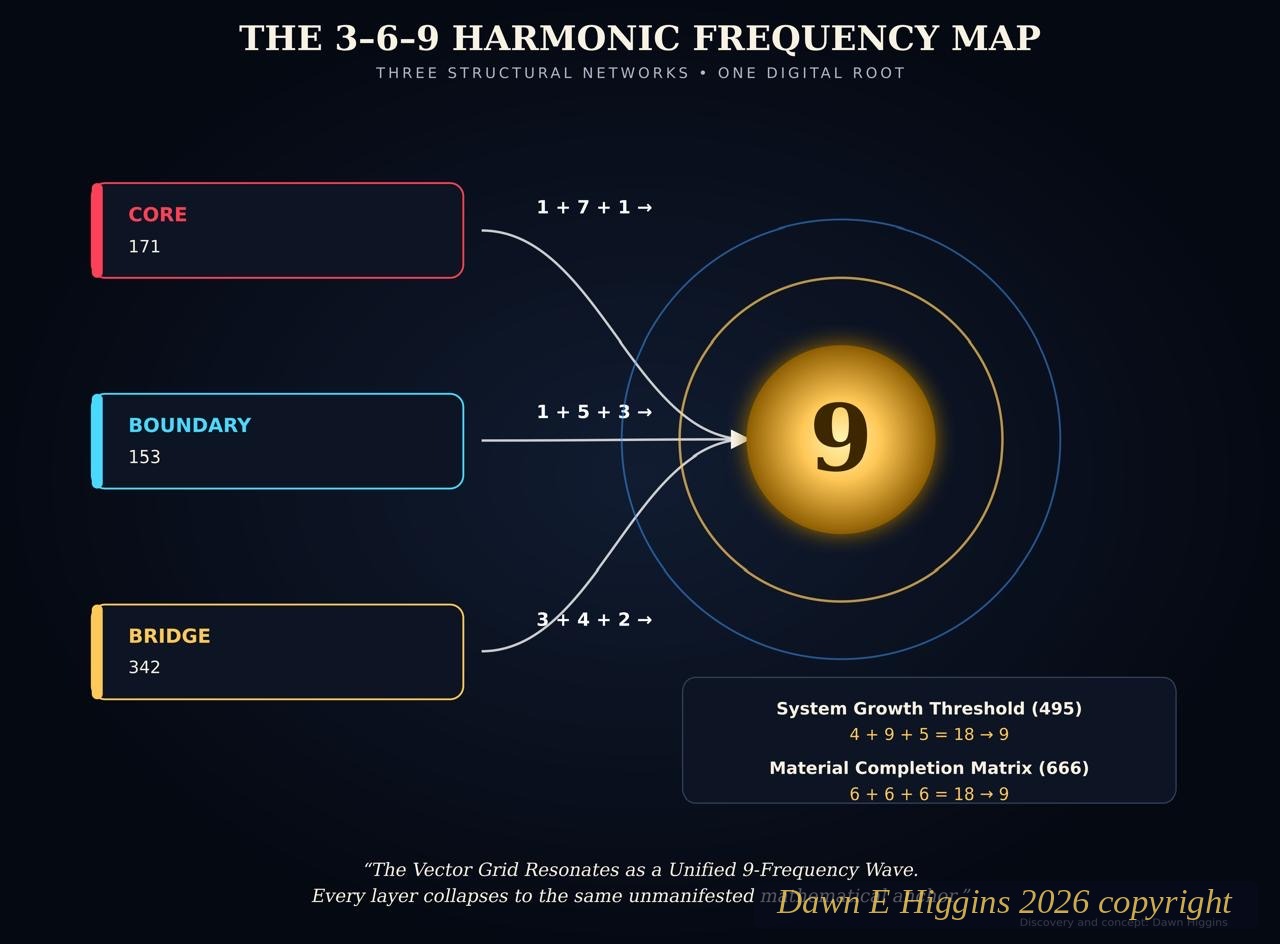
Core, boundary, and bridge. One digital root. Dawn E Higgins 2026 copyright.
Kaprekar’s routine
Begin with a three-digit number containing at least two different digits.
Arrange its digits in descending order.
Arrange the same digits in ascending order, retaining leading zeroes.
Subtract the smaller number from the larger.
Repeat.
For example:
954 − 459 = 495
Once the routine reaches 495, it remains there because the digits of 495 rearrange to 954 and 459, returning the same difference:
954 − 459 = 495
The geometry does not prove that Kaprekar’s digit routine causes the Flower, or that the Flower causes the routine.
It establishes a precise correspondence:
The same integer that acts as the fixed point of the three-digit Kaprekar process also counts the complete relational growth from 19 centres to 37.
One operation acts on digits. The other acts on geometric relationships. Both isolate 495.
The general growth law
The same internal-and-bridge division continues through every complete Flower ring. The 495 result is not a calculation detached from the sequence. It is the third exact relational increment, and the increment that coincides with Kaprekar’s constant.
| Expansion | New centres | Previous relationships | New relationships | Completed relationships |
|---|---|---|---|---|
| 1 → 7 | 6 | 0 | 21 | 21 |
| 7 → 19 | 12 | 21 | 150 | 171 |
| 19 → 37 | 18 | 171 | 495 | 666 |
| 37 → 61 | 24 | 666 | 1,164 | 1,830 |
For complete ring number k, the exact increase in relationships is:
ΔR(k) = 3k(6k2 + 1)
This produces:
21, 150, 495, 1,164, 2,265, 3,906 …
The 61-centre layer obeys the same law. Its increment is 1,164, not 495. It is the next stage of the expansion, not a second Kaprekar fixed point.
This distinction strengthens the discovery. The argument does not search every layer for 495. It identifies the one exact layer at which the established growth law naturally produces it.
What is claimed
Two independent mathematical operations produce the same integer.
Kaprekar’s routine isolates 495 as the fixed point of three-digit rearrangement and subtraction.
The Flower’s complete network isolates 495 as the pair-count of the 19-to-37 expansion.
The claim is this correspondence and the exact network that produces it:
Fruit 13 → Star 37 ← Flower 19
37 centres → 666 total relationships
19-to-37 growth → 495 new relationships
This work does not claim that Kaprekar designed the Blossom, that the Blossom causes his routine, or that the known mathematical ingredients were previously unknown.
The discovery lies in bringing those ingredients together and identifying their precise relational convergence at 37.
The number 495 is not being added symbolically to the geometry. It is generated by the geometry’s own pair-count.
Conclusion
The centred star pathway passes from 13 to 37.
The centred-hexagonal Flower pathway passes from 19 to 37.
At their meeting, the complete 37-centre network contains 666 unique relationships. The difference between that field and the preceding 19-centre Flower is exactly 495:
K37 − K19 = 495
The result can also be seen directly inside the new ring:
153 + 342 = 495
And within the completed body:
171 + 495 = 666
The Flower grows by adding centres.
The Blossom emerges through the relationships between them.
About the discovery
The Blossom of Life is the name given by independent researcher Dawn E. Higgins to the overlooked 37-centre stage and its relational interpretation.
Centred-hexagonal numbers, centred star numbers, complete pair networks and Kaprekar’s constant are established mathematics. The original contribution presented here is their synthesis at the 37-centre stage and the identification of 495 as the exact relational growth from 19 to 37 centres.
Discovery, synthesis and relational interpretation by Dawn E. Higgins.
© 2026 Dawn E. Higgins. All rights reserved.
The Blossom of Life. 1 to 37.